
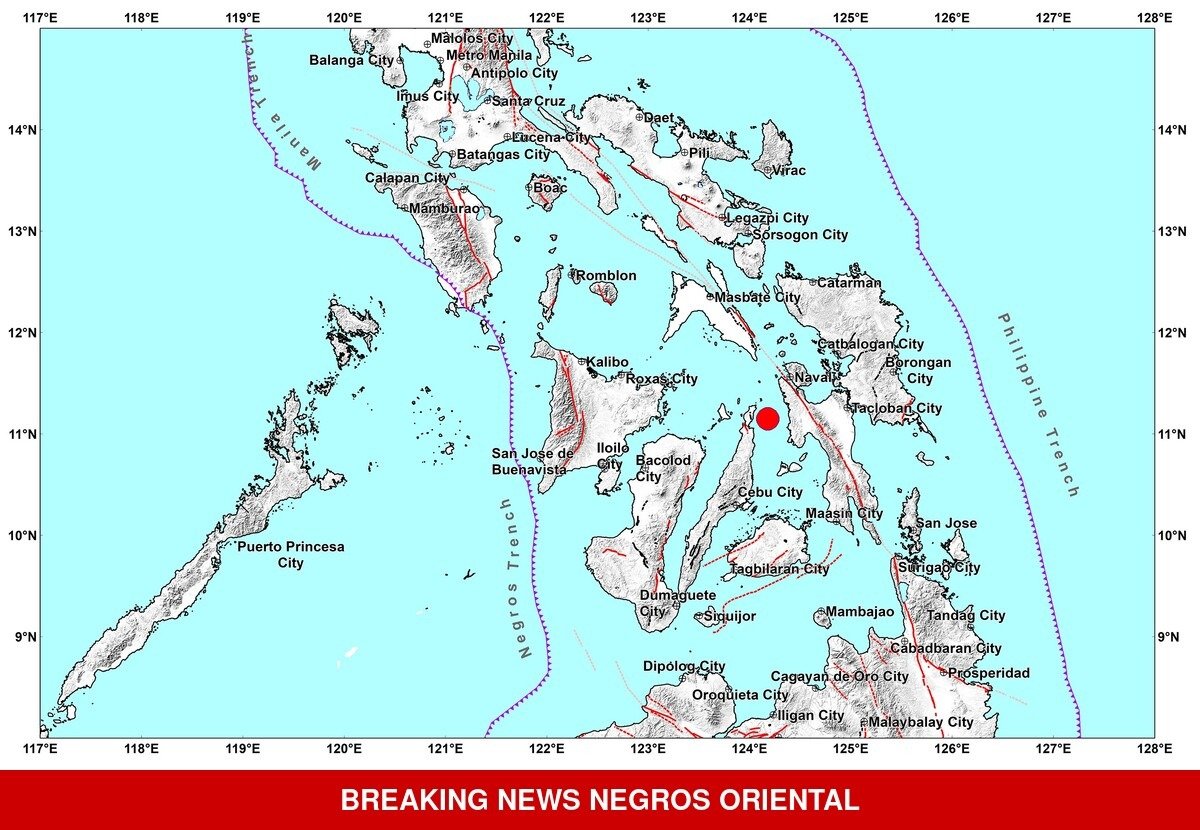
A 3.4 magnitude earthquake struck the waters off northern Cebu early Saturday morning, according to the Philippine Institute of Volcanology and Seismology (PHIVOLCS). The tremor was recorded at 7:19:54 AM on March 15, 2026, approximately 25 kilometers north 64 degrees east of Bogo City in Cebu.
PHIVOLCS confirmed the earthquake originated from tectonic activity at a shallow depth of 8 kilometers beneath the sea floor. The seismic event was identified as an aftershock of the powerful magnitude 6.9 earthquake that struck offshore northern Cebu on September 30, 2025.
No Damage or Additional Aftershocks Expected
According to the official earthquake bulletin issued by PHIVOLCS at 7:28 AM, no damage is expected from the Saturday morning tremor. The agency also stated that no additional aftershocks are anticipated from this particular seismic event.
The earthquake’s epicenter was located at coordinates 11.14°N latitude and 124.18°E longitude, placing it in the waters of the Visayan Sea between northern Cebu and southern Leyte. This location falls within the seismically active region that has experienced increased tectonic activity since the major earthquake event in September 2025.
PHIVOLCS prepared the earthquake information bulletin through the collaborative efforts of seismologists JAB, JSO, JJBF, and GBIE, who monitor seismic activity around the clock from the agency’s headquarters at the PHIVOLCS Building along C.P. Garcia Avenue in U.P. Diliman, Quezon City.
Context of September 2025 Major Earthquake
The Saturday morning earthquake represents a continuation of seismic activity that began with the significant magnitude 6.9 earthquake that struck offshore northern Cebu on September 30, 2025. That major seismic event caused considerable concern throughout the Central Visayas region and generated numerous aftershocks in the months that followed.
The September 2025 earthquake was one of the strongest to hit the Cebu area in recent years, prompting widespread evacuation procedures and damage assessments across multiple provinces in the region. The event highlighted the ongoing tectonic activity along the Philippine archipelago’s complex fault systems.
Since that major earthquake, PHIVOLCS has continued to monitor the region closely for aftershock activity. While the frequency and intensity of aftershocks typically decrease over time, seismologists note that aftershocks can continue for months or even years after a significant earthquake.
Regional Seismic Monitoring
The waters surrounding northern Cebu fall within one of the Philippines’ most seismically active zones, where multiple tectonic plates interact beneath the ocean floor. The region sits along the Philippine Sea Plate boundary, where constant geological pressure creates frequent seismic activity.
For residents of Negros Oriental and neighboring provinces, earthquakes originating from the northern Cebu area can sometimes be felt depending on their magnitude, depth, and local geological conditions. The relatively shallow depth of Saturday’s earthquake at 8 kilometers made it more likely to be detected by sensitive seismic instruments, though its moderate magnitude limited its range of impact.
PHIVOLCS operates a comprehensive network of seismological stations throughout the Philippines to detect and analyze earthquake activity. This network enables rapid assessment and public notification of seismic events, providing crucial information for disaster preparedness and public safety.
Public Advisory and Information Access
In its official bulletin, PHIVOLCS emphasized that Saturday’s earthquake information represents the only bulletin that will be issued for this particular event unless additional relevant information becomes available. This standard practice helps prevent confusion and ensures the public receives accurate, verified information about seismic activity.
The agency continues to advise the public to refer to the latest earthquake information posted on the official PHIVOLCS website at https://www.phivolcs.dost.gov.ph for the most current and reliable seismic data. This online resource provides real-time earthquake monitoring information and serves as the authoritative source for seismic activity throughout the Philippines.
Citizens can access detailed earthquake bulletins, intensity maps, and safety information through the PHIVOLCS official website, which maintains comprehensive records of all significant seismic events affecting the country.
Implications for Regional Preparedness
While Saturday’s earthquake posed no immediate threat, it serves as a reminder of the ongoing need for earthquake preparedness throughout the Central Visayas region. Local government units continue to maintain emergency response protocols developed in response to the September 2025 major earthquake.
The continued aftershock activity, though diminishing in intensity, underscores the importance of maintaining earthquake preparedness measures in households, schools, and workplaces throughout the region. Emergency officials recommend that residents keep emergency supplies readily available and review family emergency plans regularly.
For maritime operations in the area, Saturday’s earthquake did not trigger any tsunami warnings or maritime advisories. However, vessel operators continue to monitor PHIVOLCS bulletins as part of standard safety protocols for navigation in seismically active waters.
The earthquake monitoring continues as part of PHIVOLCS’s ongoing commitment to public safety and scientific understanding of seismic activity throughout the Philippine archipelago. Regular monitoring and rapid reporting help ensure that communities receive timely information about seismic events that may affect their safety and daily activities.
Photo credit: Photo courtesy of PHIVOLCS/DOST
Stay informed — get Negros Oriental news weekly
Free newsletter, no spam. Unsubscribe anytime.